Claims Investigations
Workers’ compensation, AOE/COE, statements, surveillance, records, canvasses, subrogation, and field strategy built around the decision the evidence needs to support.
INVESTIGATOR · LEADER · STRATEGIST
I work at the intersection of investigations, claims strategy, and intelligence—helping claims and SIU professionals move from suspicion to evidence, and from information to action.
Red flags tell us where to look. Evidence tells us what happened.
PROFESSIONAL FOCUS
Strong investigative work is not measured by how much activity is performed. It is measured by whether the right facts were developed, tested, documented, and communicated clearly enough to move the claim forward.
Workers’ compensation, AOE/COE, statements, surveillance, records, canvasses, subrogation, and field strategy built around the decision the evidence needs to support.
Evidence development across claimant fraud, premium fraud, undisclosed employment, business activity, open-source intelligence, and referral-ready investigative analysis.
Turning operational complexity into a clear client experience through investigation planning, escalation, quality control, communication, and practical claims support.
Practical frameworks, field tools, training, and educational content that connect investigative methods to claims decisions and professional standards.
HOW I APPROACH THE WORK
Define the decision and the evidence gap before selecting the investigative method.
Corroborate information, develop competing explanations, and let the evidence refine the direction.
Separate facts, indicators, inference, and unresolved issues so the next decision-maker has a defensible record.
FEATURED INSIGHTS
Claims Field Guide is an independent educational resource focused on investigative strategy, field tools, fraud, claims intelligence, and better decision support.
Explore Claims Field GuideAn investigation should begin with a decision and an evidence gap—not a menu item.
Read field note → SURVEILLANCEUse surveillance to answer a defined question. If the question is unclear, the field assignment probably is too.
Read field note → SUBROGATIONRecognize third-party exposure, preserve time-sensitive evidence, and build the factual record early.
Explore topic →EXPERIENCE
For more than two decades, my work has centered on a consistent problem: how to take incomplete, conflicting, or high-stakes information and turn it into a clearer operational decision.
That perspective now informs my work across workers’ compensation investigations, SIU, client services, field operations, investigative strategy, training, and emerging claims intelligence.
Leadership across workers’ compensation, SIU, AOE/COE, surveillance, investigative operations, training, and complex client relationships.
Security operations, surveillance, emergency-response training, patrol functions, and risk reduction supporting a large federal facility.
Physical security, threat assessment, access control, video systems, complex implementations, and enterprise client support.
CREDENTIALS
Credentials are useful when they reinforce disciplined practice—not when they substitute for it.
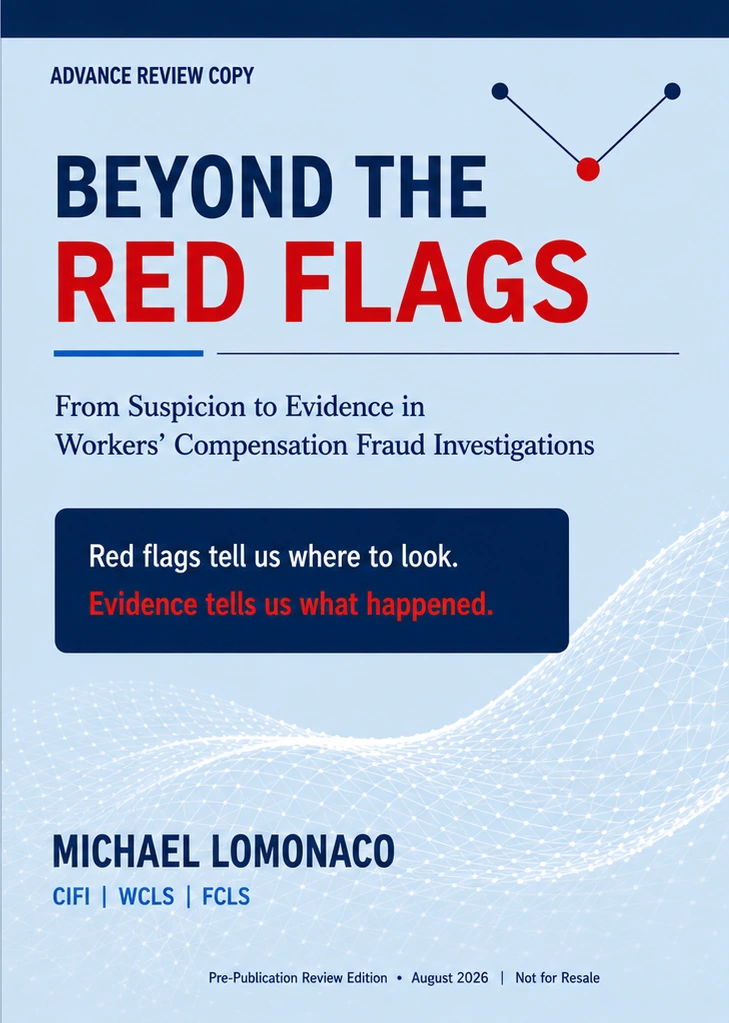
FEATURED BOOK · PRE-PUBLICATION
From Suspicion to Evidence in Workers’ Compensation Fraud Investigations
Fraud investigations rarely begin with proof. They begin with a discrepancy, a question, or a red flag that deserves closer examination. The challenge is knowing what to do next.
The book connects investigative theory, surveillance, AOE/COE, open-source research, premium fraud, interviews, documentary evidence, reporting, referrals, and professional ethics into a practical evidence-development framework.
“Fraud investigations should never be anti-claimant, anti-employer, or pro-denial. They should be pro-evidence.”Pre-Publication Review Edition · 2026
SPEAKING & TRAINING
Training works best when people can take the framework back to a real file the next morning. Topics are built around investigation planning, evidence development, claims decision support, and practical field application.
CONNECT
For industry networking, speaking, training, thought leadership, and professional collaboration.